Conduction Lens: What a 12-Lead ECG Can and Cannot Identify
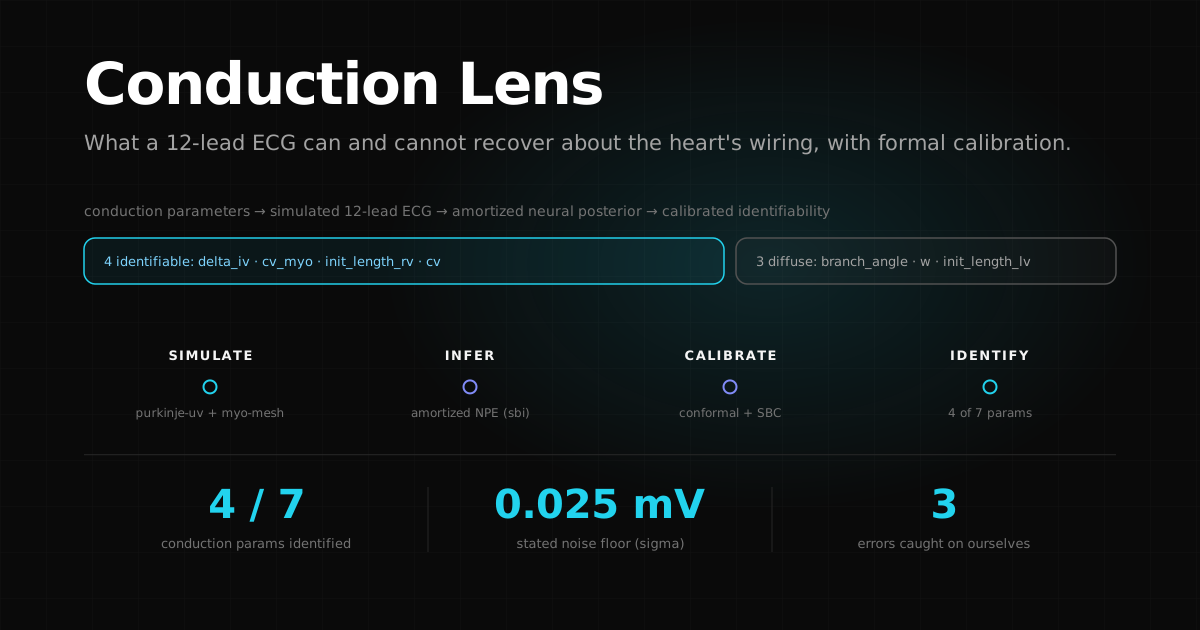
Which His-Purkinje conduction parameters a 12-lead ECG can identify: 4 of 7, with formal calibration.
Looking only at a 12-lead ECG, which parts of the heart's wiring can you actually pin down? A calibrated neural posterior answers: of seven conduction parameters, four are recoverable and three are not, at a stated noise level. All simulated ECGs, no patient data - a method, not a clinical result.
No real ECG appears anywhere in this project. Every target is simulator output (an inverse-crime setting) on a single fixed geometry, at a stated noise floor. "Identifiable" means identifiable in simulation; comparison against measured ECGs is future work.
Situation
A 12-lead ECG is cheap and everywhere, but the His-Purkinje conduction system that shapes it is hard to observe directly. Which of its parameters can the surface ECG actually recover, and which are wishful thinking? Answering that honestly needs a posterior you can trust, not just a point estimate.
Task
Build a calibrated, amortized characterization of exactly which cardiac conduction parameters a 12-lead ECG identifies at a stated observation-noise floor - a scientific finding, formally calibrated, with every claim checkable against a source.
Action
- Simulated 12-lead ECGs from cardiac conduction parameters using the author's own purkinje-uv and myocardial-mesh libraries (fractal Purkinje generation, eikonal activation, a Gima-Rudy pseudo-ECG), all CPU-only.
- Trained an amortized Neural Posterior Estimator (sbi, PyTorch) over the 7-parameter prior so any new ECG inverts in a single forward pass, then applied per-parameter conformal recalibration so the reported uncertainty is honest.
- Verified calibration with simulation-based calibration (SBC) and TARP, and ran confirmation experiments (a ridge test, a Fisher-information / CRLB analysis) so the identifiability verdict rests on a calibrated posterior, not raw contraction.
- Shipped an interactive demo (FastAPI serving real posteriors, Next.js UI with 3D activation maps) as a static export on AWS S3 + CloudFront.
How it works
Conduction parameters run through the author's own purkinje-uv + myocardial-mesh simulator to a 12-lead pseudo-ECG, then an amortized neural posterior estimator (sbi) inverts it and conformal recalibration makes it honest. No real ECG anywhere - every target is simulator output.
Result
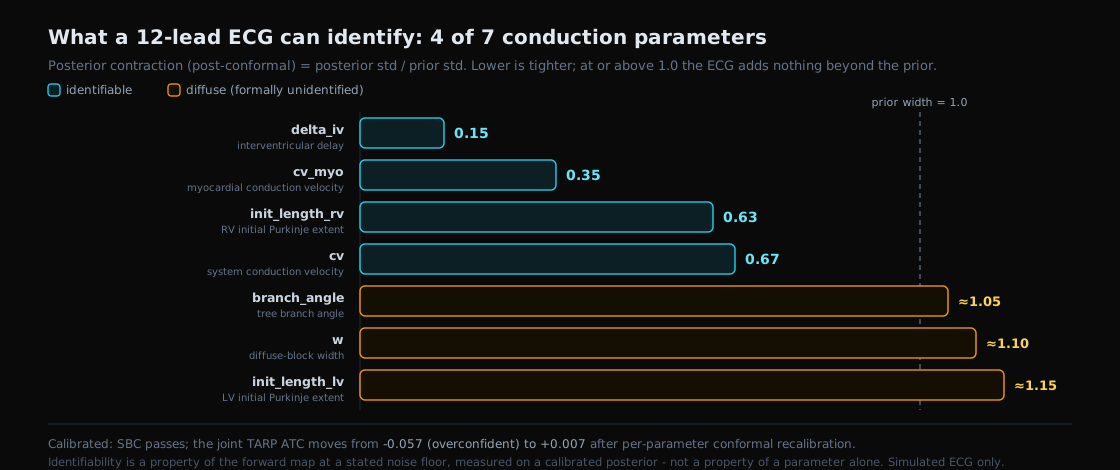
A calibrated 7-parameter identifiability spectrum at the operating noise floor (sigma = 0.025 mV): the interventricular delay (delta_iv, contraction 0.15) and myocardial conduction velocity (cv_myo, 0.35) are tightly constrained, RV initial length (0.63) and system CV (0.67) are moderately constrained, and the branch-angle, diffuse-block width, and LV-initial-length tree-shape parameters (~1.0 to 1.2) are formally unidentified - 4 of 7 informative. Calibration passes (SBC), and the joint TARP ATC moves from -0.057 (overconfident) to +0.007 after conformal recalibration.
Explore it live
The same forward model on two hearts, each with its grown LV and RV Purkinje trees: the crtdemo rig the study runs on, and a public Strocchi four-chamber anatomy. Drag to orbit, scroll to zoom, toggle the Purkinje layers, and play the wavefront to watch the depolarization propagate.
crtdemo rig
Strocchi four-chamber
Learning
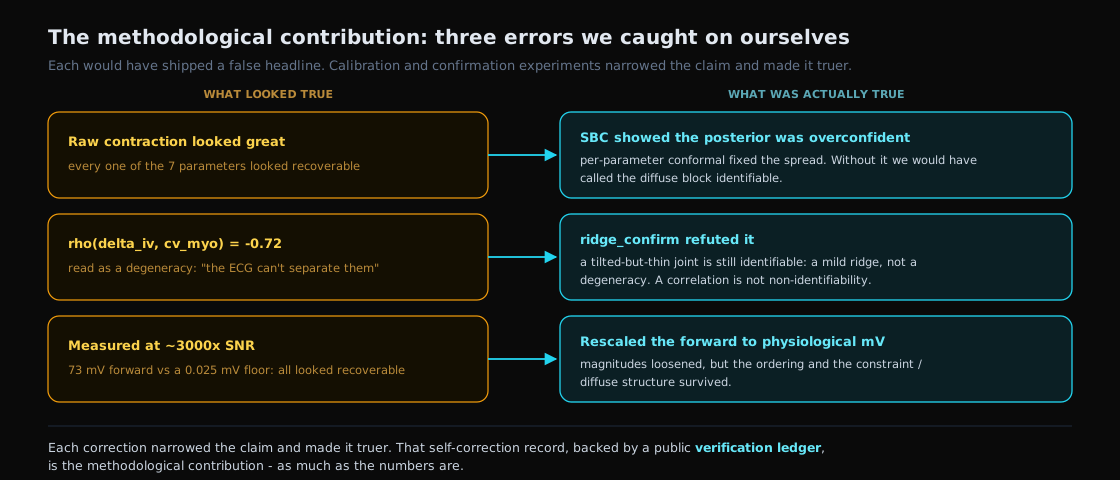
Identifiability is a property of the forward map relative to a stated noise floor, measured on a calibrated posterior - not a property of a parameter in isolation. The contribution is as much the self-correction record as the numbers: SBC caught an overconfident posterior, a ridge-confirmation experiment refuted a claimed degeneracy, and an audit found a 3000x signal-to-noise error. Each correction narrowed the claim and made it truer, backed by a public verification ledger.
Apache-2.0, built with Claude: Life Sciences. Weights and calibration artifacts ship in the v0.1.0-submission release; DOI 10.5281/zenodo.21315609.
Tech Stack
Services
Status
Live